IT4LIA AI Factory, Europe’s New AI Supercomputer
11 May 2026
EdgeConneX targets Italy with three new hubs between Milan and Lodi
19 May 2026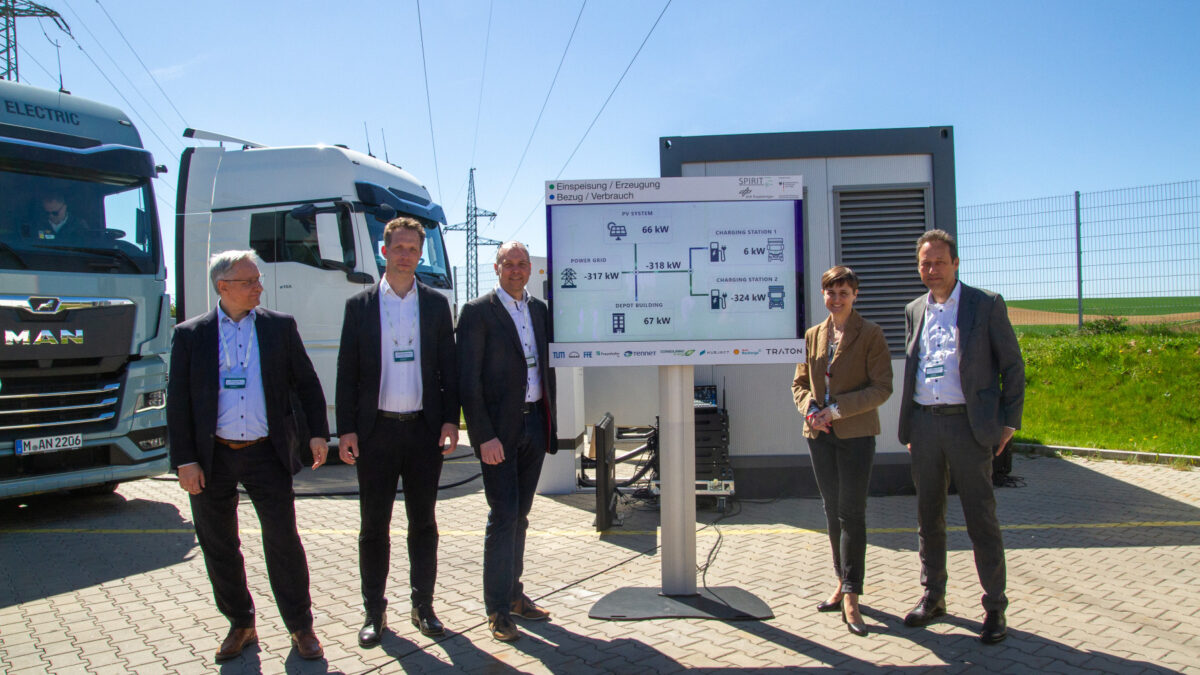
For the first time in Europe, an industrial vehicle manufacturer is bringing bidirectional charging for electric trucks onto the road – and testing it under real-world conditions. The protagonist is MAN Truck & Bus, which, with the SPIRIT-E project, is taking a concrete step toward integrating freight transport and energy systems.
The demonstration took place at the logistics site of Spedition Schmid, near Regensburg, where a MAN eTGX electric tractor unit with 480 kWh of usable capacity showed how a heavy-duty vehicle can not only consume energy, but also store and return it to the system. The result? The truck becomes a mobile energy storage unit, capable of supporting buildings, other vehicles, and even the power grid.
At the core of the project are three key applications: Vehicle-to-Vehicle (V2V), Vehicle-to-Site (V2S), and Vehicle-to-Grid (V2G). In the first case, energy is transferred from one vehicle to another; in the second, it is used directly at company sites, for example to reduce peak demand or increase self-consumption from solar power; in the third, the eTruck can feed electricity back into the public grid during peak demand or when prices are highest.
According to estimates, intelligent energy flow management can reduce electricity costs by 10% to 20%. In practical terms, for a truck covering 100,000 km per year, this could mean up to 20,000 km “at zero energy cost,” significantly improving the total cost of ownership compared to diesel vehicles.
Intelligent nodes in a distributed energy network
“Bidirectional charging fundamentally changes the role of the electric truck: from a simple energy consumer to an active element of the energy system,” explained Georg Grüneißl, Head of Product Strategy at MAN. “With SPIRIT-E, we demonstrate that eTrucks can contribute both to cost reduction and grid stability.”
The project has already validated concrete use cases, ranging from overnight building power supply using electric trucks to charging passenger cars directly from a heavy-duty vehicle’s battery. However, the technology is not universal: it requires compatible operational environments, such as regional fleets with annual mileage below 100,000 km and suitable downtime at depots.
SPIRIT-E is the result of broad collaboration across the value chain, involving the Technical University of Munich (TUM) as consortium leader, along with Fraunhofer IEE, FfE, SBRS (Shell), TenneT, Hubject, Consolinno Energy, and MAN itself. Together, they are testing solutions in a real-world laboratory, integrating mobility, infrastructure, and energy systems.
The message is clear: electric trucks will not only be means of transport, but intelligent nodes in a distributed energy network. And with this demonstration, MAN positions itself at the forefront of a transformation set to redefine the sector in the coming years.
Innovative technologies for the production and recycling of electric and hybrid vehicles will be presented at E-Tech Europe, taking place 7–9 October 2026 at BolognaFiere, as part of Urban Tech 2026 – The Urban Technology Show, the new event dedicated to e-mobility, traffic, commuting, security, telecommunications & data, and environment.
Subscribe to our newsletter and follow us on social media to stay updated on industry news and the next edition of E-Tech Europe!