Germany: incentives drive the EV market to record highs
30 June 2026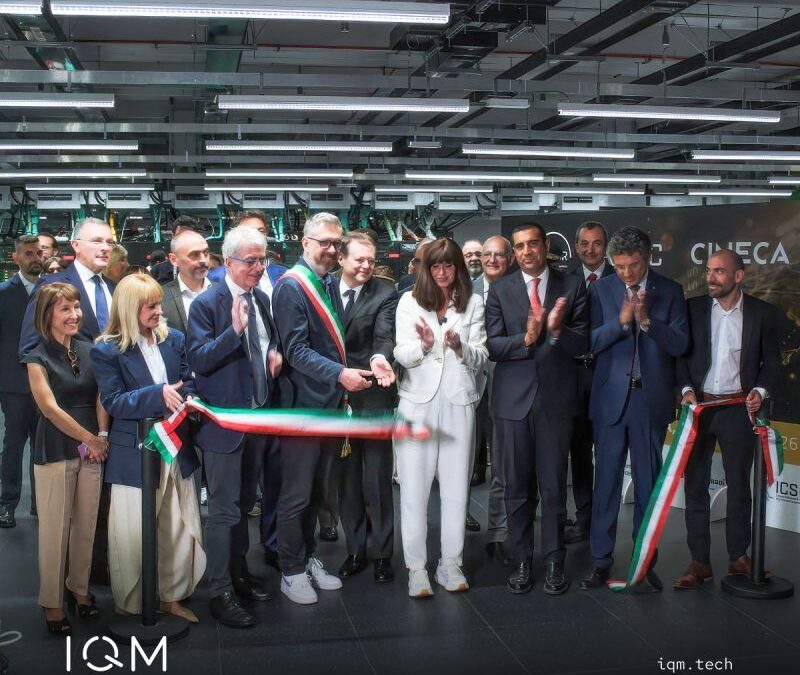
A piece of news coming from Bologna could have very concrete implications for the future of electric mobility in Italy. At the CINECA DAMA Technopole, NOX has been inaugurated—the new 54-qubit quantum computer developed by IQM and integrated with Leonardo, one of the most powerful supercomputers in the world.
At first glance, this may seem like news intended only for specialists, but it is highly relevant to companies working on next-generation batteries, smart charging systems, fleet energy management, and even autonomous driving technologies.
The real breakthrough is not simply the activation of Italy’s second operational quantum computer. What matters is that this infrastructure is now part of a national ecosystem that provides researchers, universities, startups, and businesses with computing capabilities that were previously accessible only to major international research centers.
Thanks to the integration of traditional high-performance computing and quantum computing, technology developers can tackle extremely complex problems much faster. Consider, for example, the search for new materials to increase battery range, the optimization of charging networks, or the simulation of energy scenarios involving thousands of connected vehicles. In all these areas, the ability to process vast amounts of data represents a decisive competitive advantage.
The role of CDP Venture Capital
The inauguration of NOX marks another important step in Italy’s strategy to strengthen its technological autonomy in the most advanced sectors of the digital economy.
For innovative companies, however, the issue is not only access to computing power. The truly significant development is the emergence of a value chain that connects research, technological development, and access to capital.
Once a project has been developed and validated through infrastructures such as those available at CINECA and within the ICSC ecosystem, startups can also look to the opportunities offered by CDP Venture Capital, one of the country’s key instruments for supporting the growth of strategic technologies.
It is no coincidence that among the priority sectors are artificial intelligence, quantum computing, photonics, high-performance computing, advanced robotics, and autonomous driving—fields that will have a direct impact on the future of automotive innovation and electric mobility.
The numbers help illustrate the scale of the opportunity. By 2025, the Italian artificial intelligence market had already reached a value of €1.8 billion, growing by 50% in a single year. To support this evolution, CDP Venture Capital has allocated a total of €1 billion to the development of Italy’s AI and deep-tech ecosystem. More than €300 million has already been invested, while over €500 million in additional funding is planned over the next three years.
For startups operating in battery technology, energy management software, autonomous driving systems, or charging infrastructure, the message is particularly compelling. Today, companies in Italy can access advanced research facilities, leverage world-class computing resources to develop and validate new solutions, and then seek the financial support needed to transform a technological project into a business capable of competing in global markets.
The launch of NOX is therefore much more than a technological milestone. It is a signal of a broader strategy aimed at creating a complete pathway from research to market, capable of supporting the emergence of the next generation of innovative Italian companies. And in a rapidly evolving sector such as electric mobility, this may represent one of the most significant opportunities of recent years.
Innovative technologies for the production and recycling of electric and hybrid vehicles, serving the automotive, transportation, and industrial sectors, will be showcased at E-Tech Europe, taking place from October 7–9, 2026, at BolognaFiere as part of Urban Tech 2026 – The Urban Technology Show, a new event dedicated to e-mobility, traffic, commuting, security, telecommunications & data, and environmental technologies.