Vulcan Secures New Lithium Licence: Lionheart Project Targets 500,000 EV Batteries a Year
22 September 2026
Prima Electro: expertise and engineering capabilities for grid and energy electrification at E-Tech Europe 2026
23 September 2026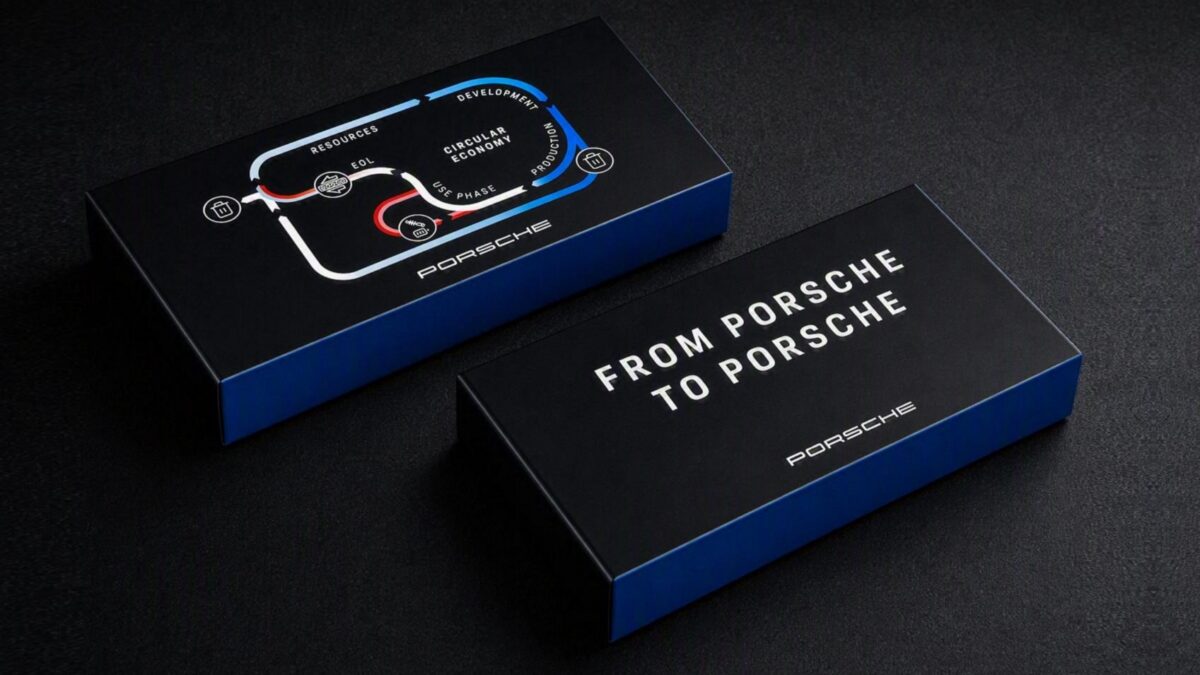
Porsche has produced battery cells using cathode active material made exclusively from recycled raw materials for the first time. The achievement comes as part of a pilot project focused on recycling high-voltage batteries, developed in collaboration with partners including German recycling specialist cylib.
The goal is to move closer to a circular model in which the raw materials contained in end-of-life batteries can be recovered and reused to manufacture new battery cells.
From recycling to a new battery
The project starts with high-voltage batteries from Porsche vehicles. After collection, the batteries are discharged, dismantled and mechanically shredded. The resulting material is then processed into what is known as black mass, from which several valuable raw materials can be recovered.
The latest stage of the project represents another step forward: Porsche has used cathode active material in which lithium, nickel, cobalt and manganese are sourced entirely from recycled materials for the first time.
The cells produced using these materials are currently undergoing operational testing. Porsche aims to determine not only whether the raw materials can be recovered, but also whether recycled materials can meet the standards required for use in high-performance batteries.
“With battery cells made entirely from recycled raw materials such as lithium and cobalt, we have achieved an important technological milestone,” said Joachim Scharnagl, Member of the Executive Board for Procurement at Porsche.
The role of cylib
As part of the project, Porsche is working with cylib, a German company specializing in lithium-ion battery recycling. The company uses a process that, according to Porsche, enables raw materials to be recovered through a water-based treatment process.
The idea is to create a closed-loop system in which Porsche batteries reaching the end of their first life can provide the raw materials needed for new batteries potentially destined for Porsche vehicles.
“The pilot project with Porsche demonstrates that our approach is feasible in practice,” said Lilian Schwich, Co-CEO and Co-Founder of cylib.
End-of-life batteries collected in Germany
The project is not limited to batteries used for testing. Since May 2026, Porsche has been recycling end-of-life high-voltage batteries collected from Porsche Centres in Germany through the partnership.
The recovered raw materials are tracked through a dedicated material accounting system. According to Porsche, these resources will be available to Porsche and selected partners for battery cell production from 2028 onwards.
The approach could help reduce dependence on mined raw materials and global supply chains, at least for part of the materials required to manufacture batteries.
The key challenge remains the quality of recycled materials
Achieving 100% recycled raw materials in cathode active material is an important process milestone, but Porsche stresses that the project is still in the testing phase.
The next step will be to verify the performance and quality of the recovered materials. Initial tests have already indicated that the approach is technically feasible, while further results are expected in the second half of 2026.
If the tests are successful, the findings could be used to assess the potential application of recycled materials in series-production battery cells.
Towards a more circular European supply chain
The project is part of Porsche’s broader strategy to increase the circularity of materials. For the automaker, battery recycling is not only an environmental issue but could also help increase the availability of strategically important raw materials.
The proposed model is relatively straightforward: a Porsche battery reaches the end of its useful life and is collected and dismantled; its materials are recovered and refined; those same materials can then re-enter the production chain as components for new battery cells.
If the process can eventually be scaled up for industrial production, some of the raw materials contained in batteries used in Europe could remain within the European supply chain rather than being lost when the vehicle reaches the end of its useful life.
Innovative technologies for the production and recycling of electric and hybrid vehicles, targeting the automotive, transport and industrial sectors, will be showcased at E-Tech Europe, taking place from 7 to 9 October 2026 at Bologna Exhibition Center as part of Urban Tech 2026 – The Urban Technology Show, the new event dedicated to e-mobility, traffic, commuting, security, telecommunications & data, and the environment.