Energy Group: industrial additive manufacturing systems at E-Tech Europe 2026
4 September 2026
Škoda Peaq Travels 936 km on a Single Charge in Record-Breaking Run
8 September 2026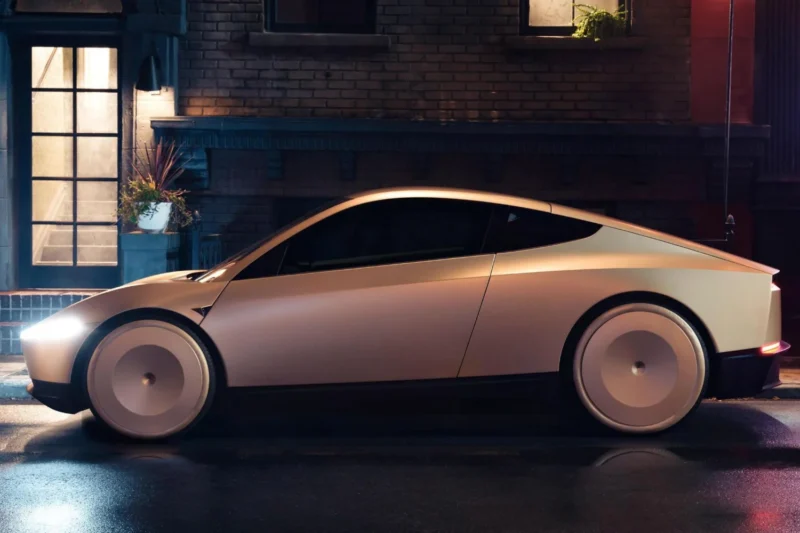
Tesla has begun deploying its Cybercab robotaxi in Austin, Texas, marking the first appearance of the purpose-built autonomous vehicle in the company’s Robotaxi service. For now, however, the rollout remains extremely limited.
The arrival of the Cybercab on Texas roads represents an important step for a project first unveiled by Tesla almost two years ago. Until now, the Robotaxi service in Austin had relied on modified Model Y vehicles equipped for autonomous driving. The Cybercab is different: it was designed from the outset to operate without traditional driving controls.
Two seats and no steering wheel: a completely different approach
The Cybercab stands apart from Tesla’s current production models. Its cabin is designed for two passengers and the vehicle has no steering wheel, pedals or conventional rear-view mirrors.
The doors are another distinctive feature, opening vertically and giving the vehicle an instantly recognizable appearance.
On the technical side, the Cybercab is equipped with a 48 kWh battery and an electric motor producing 219 hp. Tesla also plans to integrate Starlink V5 connectivity, further strengthening the connection between the vehicle and the company’s broader technology ecosystem.
The Cybercab is not intended to function like a conventional car. Instead, it has been conceived primarily as an autonomous transportation service. Passengers can request the vehicle through the Robotaxi app and use their smartphone to unlock and open the doors before getting inside.
No major Tesla-style event for the Austin launch
The way Tesla introduced the vehicle is also noteworthy. Despite the importance Elon Musk has repeatedly attached to the project, the Austin debut took place without one of the company’s usual high-profile launch events.
The presentation was held behind closed doors, with a limited number of guests and several Tesla-affiliated creators invited to experience the vehicle. There was no public livestream or major press event.
Elon Musk was not present at the launch.
The low-key presentation is particularly interesting given the expectations that have surrounded the Cybercab over the past few years. Musk has described the project as a key part of Tesla’s long-term strategy for autonomous transportation and previously suggested that the vehicle could eventually be sold to private customers for less than $30,000.
That price target was not brought back into focus during the Austin debut, leaving several questions about the model’s eventual commercial rollout unanswered.
The fleet is still very small
Another key issue is the size of the operation. Just 45 Cybercabs have reportedly been registered in Texas, a number that remains far below what would be needed to turn robotaxi operations into a large-scale business.
Tesla has not provided detailed information on how many vehicles will actually enter service or how quickly the fleet could expand.
At the same time, the company appears to be attracting interest from businesses and investors potentially looking to purchase Cybercab fleets or develop dedicated infrastructure around the autonomous vehicles.
Regulation remains the biggest challenge
The real challenge for Tesla, however, is not simply producing the vehicles. The company will also need a regulatory framework that allows a car without a steering wheel or pedals to be deployed and sold on a much larger scale.
The NHTSA, the US federal agency responsible for road-vehicle safety, is monitoring the project. Because the Cybercab lacks conventional driving controls, its wider deployment requires a specific regulatory pathway and potentially exemptions from some existing requirements.
The Cybercab has therefore finally reached public roads, but the Austin launch appears to be primarily a first real-world test. Before turning the project into a mass-market service, Tesla will have to demonstrate that its technology, safety systems, regulatory approvals and production capabilities can all scale at the same pace.
Innovative technologies for the production and recycling of electric and hybrid vehicles, targeting the automotive, transport and industrial sectors, will be showcased at E-Tech Europe, taking place from 7 to 9 October 2026 at Bologna Exhibition Center as part of Urban Tech 2026 – The Urban Technology Show, the new event dedicated to e-mobility, traffic, commuting, security, telecommunications & data, and the environment.